
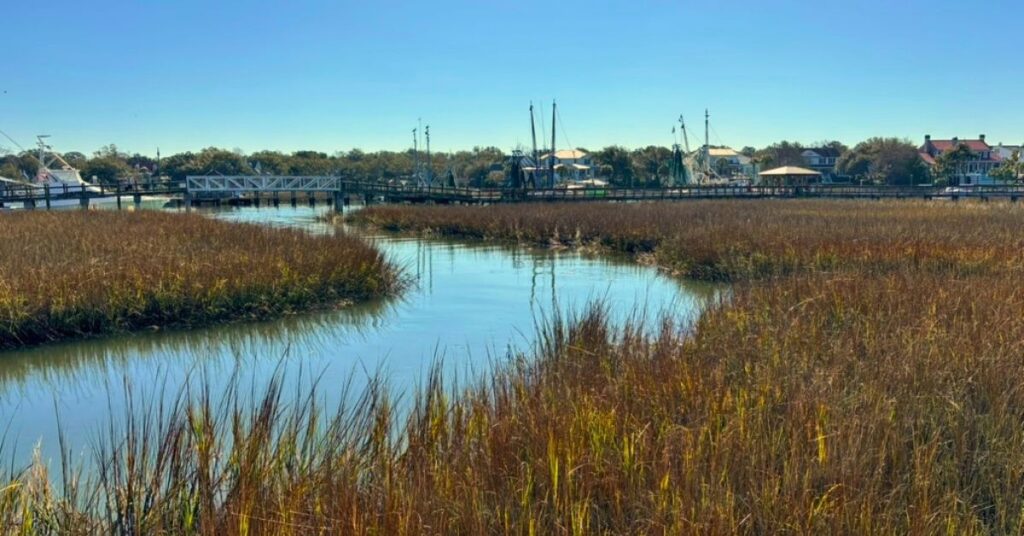
For anyone who’s spent a lot of time here in the Lowcountry of South Carolina, you’re familiar with pluff mud. It’s the thick, organic sludge of the salt marsh, the structure of the serpentine waterways that make our part of the coast so unique.
(It’s also how we could tell from the opening scenes of Netflix’s “Outer Banks” that they didn’t film a lick of the first season in North Carolina, and instead chose right down the road in the Old Village of Mt. Pleasant… but that’s another story…)
When I first moved down here in 1999, I took a job at the SC Department of Natural Resources, working on the Lady Lisa, a shrimp boat-turned-research vessel, trawling up and down the southeastern coast of the U.S. on a population survey. The project was Southeast Monitoring and Assessment Program (SEAMAP) (it’s evolved some since then), and I loved every minute on that boat. Except for the storm that gave us 10-foot waves to ride out. (yet another story…)
Anyway, between the spring and summer cruise, I helped out in another DNR lab that was studying the tiny fiddler crabs that lived in the pluff mud. One day another lab manager and I rode out through the marsh to take samples (raise your hand if you know how to sex a fiddler crab!). As soon as I jumped out, I found myself waist deep in the silky heat of decaying vegetation. And more than little crabs looking at me with interest.
I’m sure one of my rubber boots is still in that tidal creek near Fort Johnson…
So what does a lost boot in a tidal creek have to do with writing a novel, you may ask?
Sign up to get this delivered to your inbox, along with updates and announcements.
When you get stuck, more often than not, you are STUCK. There’s no backtracking. There’s no forward tracking, for that matter. Sometimes you have to wave your arms and give in to being rescued. Plucked from the mud, hoisted back over the bow of the boat, and be grateful that cell phone cameras didn’t exist back then. (ohmigosh sooo thankful)
What I should’ve done — what the lab manager was used to doing, and forgot that I was a newbie — was to go in with a plan (that both of us were clued in on), set rods in the mud as markers and a guide, and partner up to carefully gather buckets of mud loaded with crabs to take back to the lab.
Knowing this plan would’ve saved time, energy, and oh so much embarrassment.
As 24-year-old Rebecca learned, having even the most basic plan in place is immensely helpful when launching into a big project.
Getting Your Story Unstuck
Present-day much-older-Rebecca knows the same is true when writing a novel. Whether you’re waist-deep in pluff mud or somewhere in the “murky middle” of chapter 12, going in without markers is how you get stuck. Story events — or story landmarks, if you will — are the moments that have to happen for your specific manuscript.
The markers you need fall into a handful of categories. Some are structural markers — the moments every story needs, like the midpoint shift and the darkest moment before your characters can find their way through. Some markers are specific to character — the internal shifts your protagonist must make along the way for the ending to feel realistic and earned. And some are scene markers that only your story needs — the ones you first imagined when the idea took shape, that you’ve been dying to write all along.
You don’t need to map every step, but knowing where those markers are in your story can make the difference between writing with direction or writing in circles.
One of the ways I help writers identify their own story landmarks is through Author Accelerator’s Blueprint for a Book framework. It’s a guided process for getting clear on what your story is about and what it needs (before you lose a boot in the marsh!). The resulting Inside Outline can be as simple as the five major “tentpole” (shrimp pole!) scenes — the inciting incident, first plot point, midpoint, second plot point, and the climax — or as detailed as you need to track every plot event, character shift, and red herring in your novel.
How to Find Your Story Landmarks
Some practical, actionable prompts to help you find your novel’s landmarks:
- What has to happen before your ending can work?
- What is your protagonist most afraid to face, and when does she face it?
- If you removed this scene, would the story still make sense? (If it crumbles without it, it’s a landmark.)
- Where are you now, and what’s the next marker from here?
The Unmapped Middle
The middle may feel shapeless, like mud that’s been melting under the SC sun, but it probably isn’t. It just needs a bit of structure added to it along the way to guide you to what you’re heading toward.
If you’re not sure where your landmarks are — or you know where you’re headed but can’t find solid ground to stand on — that’s exactly what a coaching conversation is for. Sometimes 20 minutes is all it takes to find your footing: https://cypressandink.com/contact-me/
Unlike my rubber boot, your story isn’t lost. It just needs a marker.
Hi, I’m Rebecca Davis, developmental editor and book coach, mystery lover, and former research administrator. I traded grant proposals for plot twists and now I get to help writers find their way through the maze of story and structure. I live on the South Carolina coast, and believe every story needs both a map and a little mystery. Explore Coaching Services →