
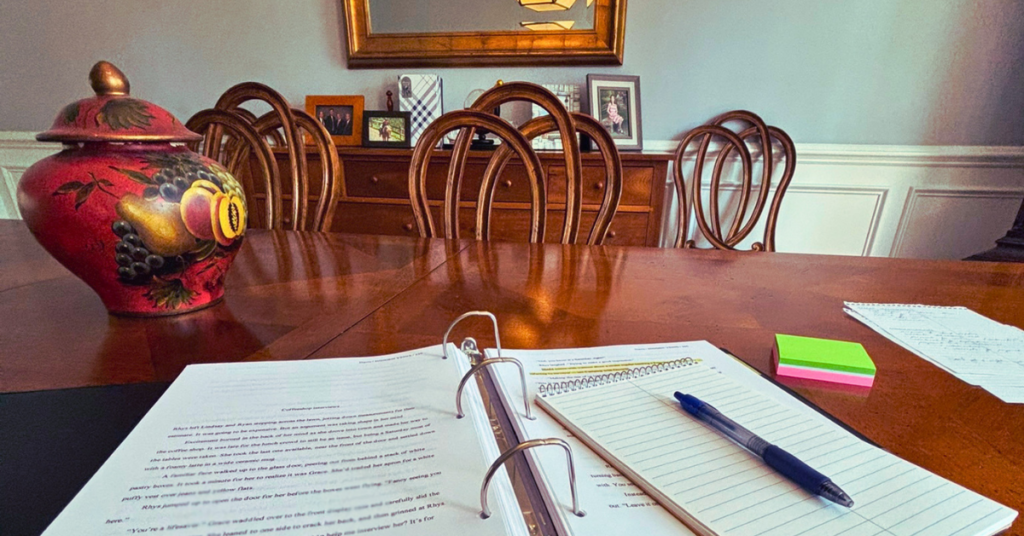
I have a 112,000-word discovery draft sitting on my desk, and I’ll be honest with you — the thought of revising it is a little terrifying. I know what needs work. That’s not what terrifies me.
I keep asking myself the questions that make any writer spiral: What if there are too many changes? What if pulling out scenes, restructuring the timeline, and aging up my protagonist by a decade means I’d be better off starting over? It’s not just the 30k words that definitely need to go just to fit market expectations for this genre. Though that’s daunting, I already know the fluff and filler scenes that no longer belong.
So if you’ve finished a draft and you’re sitting here now with questions like these, here’s my recommendation before you change a single word: read the whole thing first.
Don’t read it to fix it. Not yet. Don’t evaluate every sentence. Just go through it as a reader instead of as the writer who created it. Print out the entire manuscript, put it in a binder, and read it from start to finish without marking it up. As you go, keep a separate document open for notes. Flag pages with sticky notes if you must, but resist the urge to edit as you go. I wrote about my note-taking process in more detail here if you want a deeper look at that step.
Note: Some writers prefer to load it onto their e-reader for extra distance from the screen. A writer in our weekly co-writing Write Flow group spiral-bound a hard copy of her manuscript at a print shop to use. Do whatever it takes to create the most separation between you and the story you know so well.
This is the first big-picture pass, and it consistently delivers three things that make your first revision more focused and far less frightening.
One: You’ll know what to cut, and why
This is the one that so many writers dread (me, too), but it turns out to be the most clarifying. During your read-through, you should be able to identify pretty quickly the specific scenes that aren’t earning their place, or where you lose interest. Where the story spins its wheels. Where you wrote your way through a problem that no longer exists. In my own discovery draft, the scenes I wrote to hit a daily word count jump out at me. That silly BBQ scene bores me now, and will certainly bore a reader. A sub-plot about a controversial article that stirred up trouble for my protagonist was never resolved, so now I’m deciding whether to pull it entirely or make it earn its place.
These scenes weren’t hard to find, because I was finally reading as a reader rather than as the writer defending her choices.
Two: You’ll be able to identify where the story’s engine stalls
- Where does the momentum drop?
- Where does a character go quiet or stop reacting in a way that feels true to who they are?
- Where do you find yourself skimming ahead because the scene isn’t holding your attention?
These are structural signals, and they’re much easier to spot in a single, uninterrupted read than when you’re mired in line edits. They tell you exactly where your first revision pass needs to focus, and which scenes need to be reworked, smooshed (technical term), or cut entirely.
Three: You’ll know what’s working (this matters more than you think)
The read-through isn’t just triaging the most important structural edits. Some scenes will resonate exactly as you intended. You’ll get goosebumps over dialogue you don’t even remember writing (gotta love that flow state). At some point, you’ll remember why you wrote this story in the first place, I guarantee it.
Knowing what’s strong tells you what to protect while you fix what isn’t working. Believe me, that clarity is critical when you’re staring down a big revision.
Sign up to get this delivered to your inbox, along with updates and announcements.
The read-through won’t solve your revision. But it will give you a clear, honest picture of what you’re actually working with. This means that when you sit down to start revising, you have a target (instead of a panic attack).
And that’s where a revision plan comes in. My Story-Level Revision Map is the framework I use to take everything the read-through brings up and turns it into a prioritized, step-by-step plan you can follow. You can get your own copy at https://cypressandink.com/story-revision-map/.
Your draft is not too broken to fix. It just needs a process.
Hi, I’m Rebecca Davis, developmental editor and book coach, mystery lover, and former research administrator. I traded grant proposals for plot twists and now I get to help writers find their way through the maze of story and structure. I live on the South Carolina coast, and believe every story needs both a map and a little mystery. Explore Coaching Services →